
AI and Pragmatic Literacy: Bilingual Scribes During the Reign of Håkon Magnusson of Norway (c. 1284-1319)
The Arnamagnæan Collection preserves the largest collection of medieval Norwegian charters written in Latin, alongside a substantial number of vernacular documents. Spanning several hundred original parchments, the textual content of these documents cover a remarkable range of topics. In general, they describe international communication, as well as domestic affairs in medieval Norway. Today, they serve as invaluable sources for historical, linguistic, and palaeographic research, offering direct insight into medieval life and language use. Yet our knowledge of the scribes who produced these texts, and of the nature of their training, remains remarkably limited.

Most professional Norwegian scribes were likely capable of reading and/or writing more than one language, and there is little doubt that Latin and Old Norwegian coexisted within a shared cultural and textual environment (Ommundsen 2016). Moreover, the sheer quantity – and the highly developed stylistic features – of the Latin charters leave little doubt that the European ars notaria and ars dictandi were adopted rapidly in Norway during the latter half of the twelfth century and subsequently becoming an important part of the royal and ecclesiastical pragmatic literacy. One of the most significant periods for charter production in Norway was the reign of Duke, later King, Hákon Magnússon (ca. 1284-1319). Hákon is known to have employed a substantial number of scribes (Drechsler forthcoming). Although some may have come from abroad, the majority appear to have been trained within domestic royal or ecclesiastical institutions. This is suggested both by their vernacular bynames – such as klerkr (cleric) or prestr (priest) – and by the Latin designation notarius (notary), as well as by what is known of their professional backgrounds from contemporary sources (Helle 1973, 403–4, 409–10).
As elsewhere in Europe, two principal categories of Norwegian charters are attested (Hamre 2004, 62–68). The first comprises the royal chartae, which include law amendments, statutes, and administrative regulations, and were typically produced by scribes who are explicitly named within the documents. The second category – far more numerous in the surviving corpus – consists of the anonymous notitiae (modern Norwegian vitnebrev). These encompass a broad range of legal and administrative records, such as deeds, property transfers, and court settlements, as well as Latin letters used for both domestic and international communication. To date, however, almost nothing is known about the scribes responsible for the Latin notitiae. This is largely due to the sheer number of these documents and to the limited information their orthography provides, since their language differs little from the Latin used in charters produced elsewhere in contemporary Europe (Agerholt 1929, 623–24). By contrast, vernacular charters preserve a wide array of dialect spellings, allowing scholars to associate particular scribes with specific regions of origin. At the same time, this linguistic diversity suggests that no single centre of learning dominated during the reign of Magnús Hákonarson (Hagland 1986, 140–43).
The coexistence of the vernacular and Latin in Norwegian charters manifests itself in several areas of palaeographic overlap and mutual influence, not least due to the simple fact that the handwriting of these share the same script types. Most prominently, these include younger Gothic script types – Semitextualis, Cursiva Antiquior, Cursiva Recentior, Hybrida, and Semihybridia – which were widely used across northern Europe throughout the Late Middle Ages (Derolez 2003, 123–75; Waldersnes 2025, 89–92).
Despite these overarching macro‑palaeographic developments, handwriting in medieval documents remains a distinctly individual practice at the micro level – much as it does today. It is precisely these individualised features that recent advances in digital palaeography are increasingly able to detect, and at scales far surpassing what traditional methods allowed. One of the most successful tools for identifying such patterns is MONK, an AI‑supported handwriting recognition system developed since 2008 by the Artificial Intelligence and Cognitive Engineering Group at the University of Groningen (Schomaker 2021). Designed for processing large volumes of handwritten material, MONK enables automatic writer identification by extracting palaeographic characteristics specific to individual scribes or scribal environments.
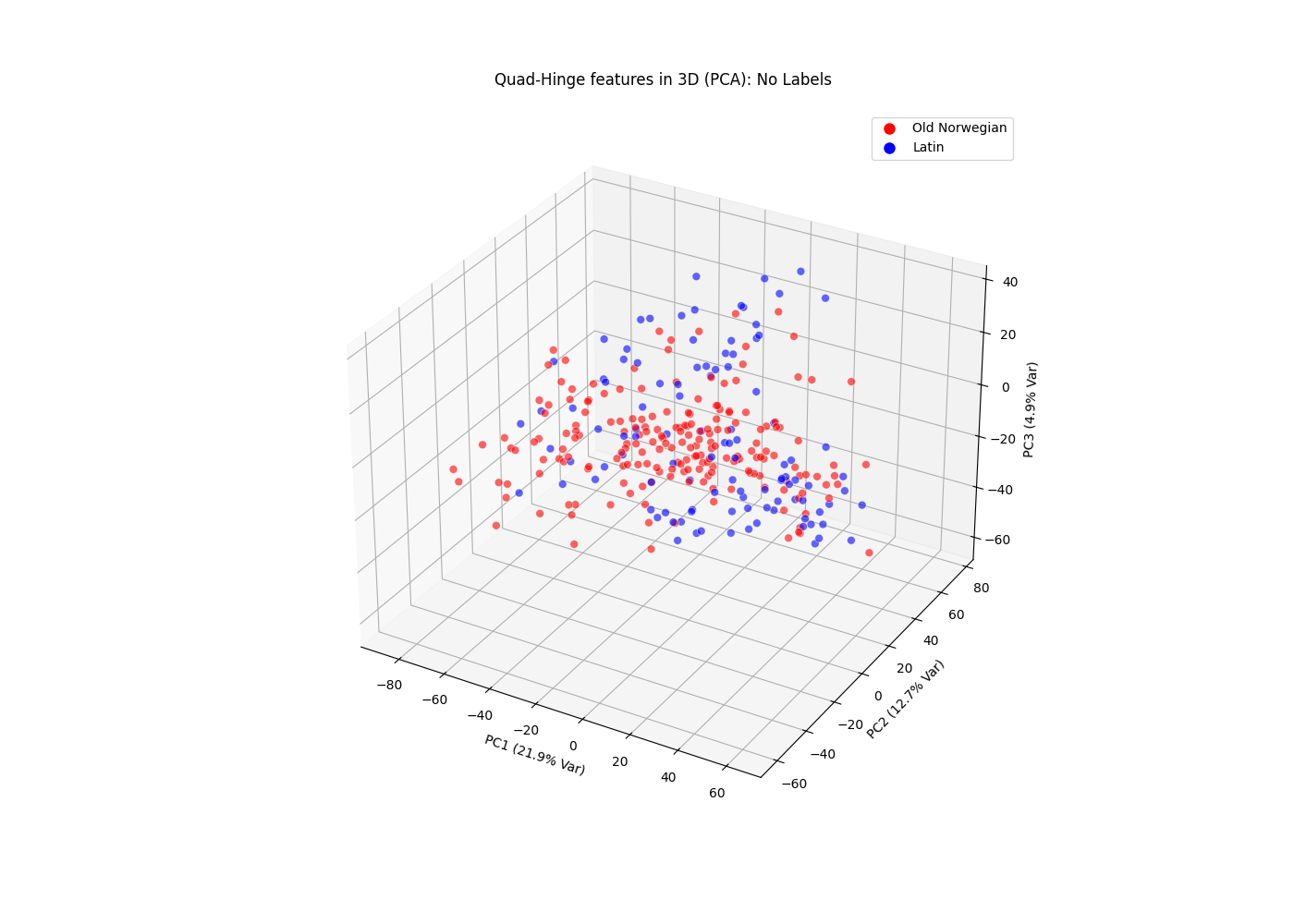
Figure 1: A plot showing a selection of charters, manuscripts, and fragments written during the lifetime of King Hákon Magnússon of Norway (Image: Maruf A. Dhali). Click on image to see larger version with labels.
In MONK, handwriting styles are detected using binarized Hinge features – segments of letter shapes in which curvature and stroke forms of handwriting are measured. In addition, through the so‑called Cloud of Line Distribution (COLD), entire components of letters are extracted from binarized script images, dominant points within letter shapes are identified, and line segments are generated (Dhali et al. 2017). These features have been attested in numerous script types, notably in those with overlapping letter forms typical of younger Gothic scripts. Together, the Hinge and COLD process steps capture highly detailed co‑occurrences in junction patterns along contours of the digitalised ink and assemble them in large quantities to identify characteristic handwriting signatures.
One way of visualising these results is through plotting such patterns in a three‑dimensional space (Popović et al. 2021). When applied to a catalogue of 235 Latin and Old Norwegian charters, as well as samples of 76 manuscripts and fragments written in Norway in one of the two languages roughly during the lifetime of Hákon Magnússon (1270-1319), a surprisingly homogenous picture appears (see Figure 1). Overall, no difference in the script type is found that separates Latin from vernacular charters, which indicates that the script type does not indicate the use of a language per sé. A similar impression is found in script types used for manuscripts, and which primarily include the Gothic script types Praegothica and Northern Textualis (Derolez 2003, 56-101). Nevertheless, also in these, younger Gothic script types are used that are otherwise primarily found in charters. Accordingly, no clear or rigid distinction between book and charter scripts can be discerned. The clusters shown in Figure 1 suggest that closely related scribal milieus were responsible for the handwriting represented there. In certain instances, the work of known scribes can be identified, particularly those associated with royal chartae, where often their names are found in the last lines of the text. From the court of King Hákon, a total of twenty‑two scribes are known by name (Drechsler forthcoming). Most bear bynames of the types mentioned above, and although their vernacular Norwegian dialects vary according to their presumed regions of origin, the scripts they employ are at times strikingly similar. This may indicate that such scribal milieus were shaped primarily by shared script traditions rather than by linguistic features. The closeness of some of the anonymous Latin charters to those Old Norwegian documents written by scribes known by name emerged from a shared scribal environment, if not written by similar scribes.
Evidence from Norwegian charters and manuscripts suggests that scribal individuality was largely independent of the language in which a text was written, provided that the underlying script type remained consistent. Recent linguistic analyses of handwritten material from the Norwegian Middle Ages further indicate that the interaction and coexistence of the diglossic traditions of Latin and Old Norwegian were far more intricate than previously assumed (Palumbo 2025). This complexity is reflected in the diagram presented here, where clusters of handwritten scripts appear to rely less on the language used but more on the script itself. Such findings, in turn, contribute significantly to identifying individual scribal habits and the centres of learning in which Latin was first taught – likely alongside other components of the standardised medieval liberal arts curriculum.
Topics
Contact
Stefan Drechsler is a researcher at the University of Bergen
Maruf Dhali is associate professor at the University of Groningen
Bibliography
Agerholt, Johan. Gamal brevskipnad. Etterrøkjingar og utgreidingar i norsk diplomatikk. I: Formelverket i kongebrev på norsk 1280–1387. Oslo: J. Chr. Gundersen bogtrykkeri, 1929.
Derolez, Albert. The Palaeography of Gothic Manuscript Books. From the Twelfth to the Early Sixteenth Century. Cambridge: Cambridge University Press, 2003.
Drechsler, Stefan, “Nos Haquinus Signauimus. Kongsbókin, Håkon Magnusson, and the Royal Chancellery,” Crown, Church, and Convent: Essays on Medieval Cultural History in Norway. Salonen, K., Baug, I. & Ommundsen, Å. (eds.). Turnhout: Brepols, forthcoming.
Dhali, Maruf A., He, Sheng, Popovic, Mladen, Tigchelaar, Eibert, & Schomaker, Lambert. “A Digital Palaeographic Approach towards Writer Identification in the Dead Sea Scrolls,” International Conference on Pattern Recognition Applications and Methods (2017), 693–702.
Hagland, Jan Ragnar. Riksstyring og språknorm. Spørsmålet om kongskanselliets rolle i norsk språkhistorie på 1200- og første halvdel av 1300-tallet. Oslo: Novus forlag, 1986.
Hamre, Lars. Innføring i diplomatikk. 2nd edition. Oslo, 2004.
Helle, Knut. Konge og gode menn i norsk riksstyring ca. 1150–1319. Bergen: Universitetsforlaget, 1973.
Ommundsen, Åslaug, “Traces of Latin Education in the Old Norse World,” Intellectual Culture in Medieval Scandinavia, c. 1100-1350. Eriksen, Stefka Georgieva (ed.). Turnhout: Brepols, 2016, 243–261.
Popović, Mladen, Dhali, Maruf A., & Schomaker, Lambert. “Artificial intelligence-based writer identification generates new evidence for the unknown scribes of the Dead Sea Scrolls exemplified by the Great Isaiah Scroll (1QIsaa),” PloS one, 16/4 (2021, 1–28.
Palumbo, Alessandro, “From the Vernacular to Latin: Social Functions and Indexicalities in Bilingual and Biscriptal Epitaphs of Medieval Scandinavia,” Scriptorium 100/4 (2025), 1045–1083.
Schomaker, Lambert. “Lifelong Learning for Text Retrieval and Recognition in Historical Handwritten Document Collections.” Handwritten Historical Document Analysis, Recognition, and Retrieval – State of the Art and Future Trends. Fischer, Andreas, Liwicki, Marcus, & Ingold, Rolf (eds.). Singapore: World Scientific Publishing, 2021, 221–248.
Vågslid, Eivind. Norske skrivarar i millomalderen. Oslo: Universitetsforlaget, 1989.
Waldersnes, Tonje. “Mønster i skrift – En tverrfaglig analyse av utvalgte norske diplomer fra 1300 til 1500.” Unpublished MA Thesis. Bergen: University of Bergen, 2024.
Funding
This entry of Manuscript of the Month was produced in connection with the research project Writing in Latin and in the Vernacular funded by the Centre for Advanced Study (CAS), Oslo.
Contribute to Manuscript of the Month
Have something to say about one or more manuscripts in the Arnamagnæn Collection? Contribute to the column Manuscript of the Month to get your research out there! Write to Seán Vrieland (sean.vrieland@hum.ku.dk) for more details.